Daily tadalafil: what a compliance percentage leaves out
A study classification compresses a medication record. Understanding that compression helps separate a prescribed schedule, observed use and the outcome someone hopes to achieve.
Published and source checked · 12 minute read
A daily medication plan contains a schedule, but a schedule is not a record of what happened. A research report can also describe a classification based on that record, then separately report symptoms or other outcomes. These objects are connected without being interchangeable. Reading them as if they were one measure can turn a narrow observation into a much broader claim about a medicine or its format.
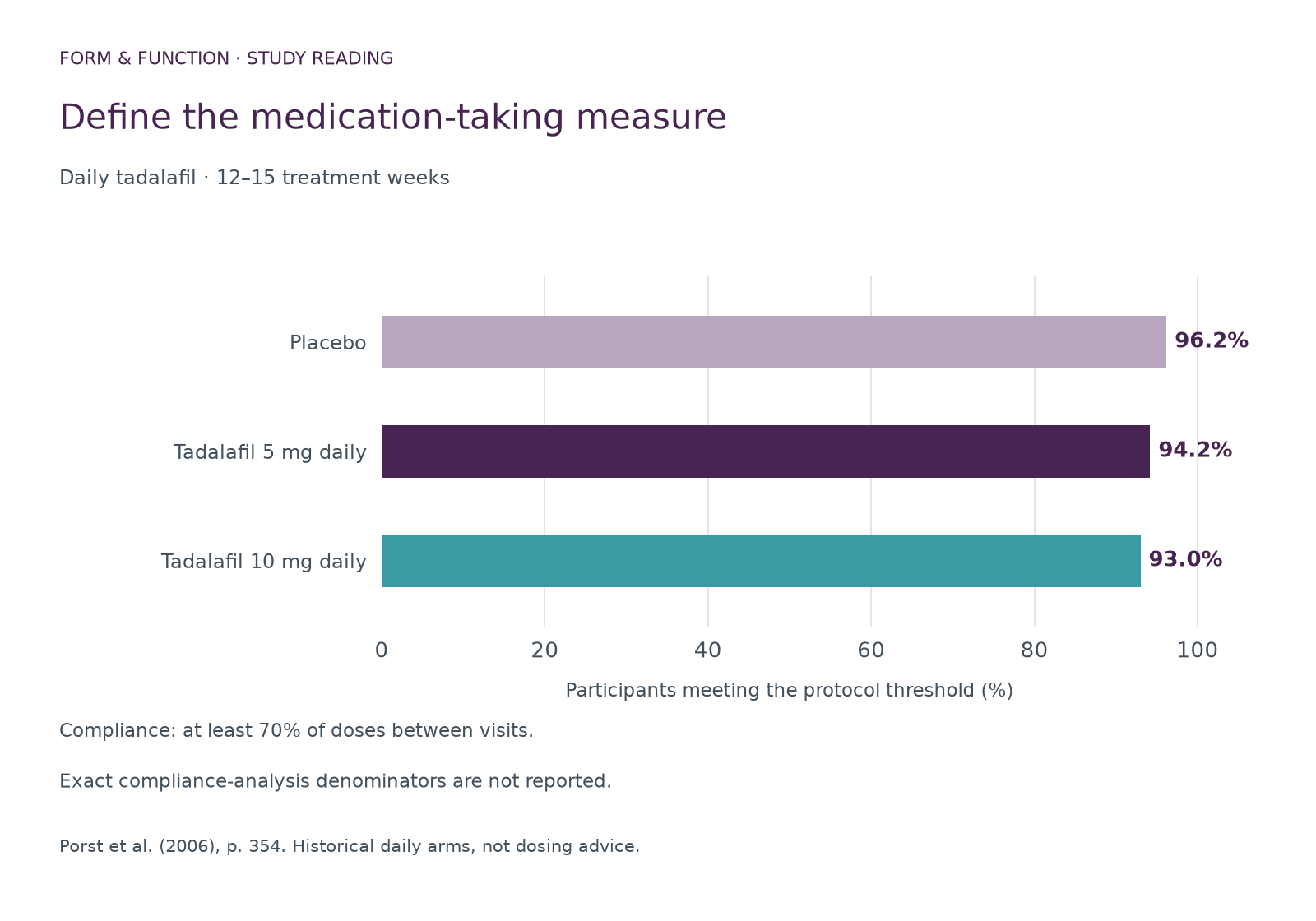
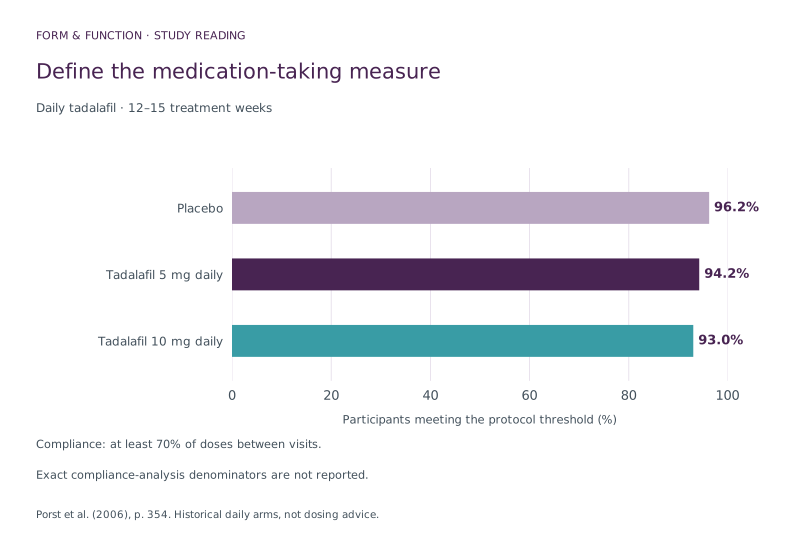
This analysis uses a historical tadalafil study as the starting point for examining those distinctions. The chart presents its reported classification results. The worked examples below are original, fictional exercises about recording ordinary checks, not reconstructed patient histories or instructions for taking medicine. Their purpose is to show which details survive a summary, which disappear, and what additional evidence a new question would require.
Reading the evidence
- Plan and observation
- A scheduled action and a recorded action answer different questions.
Sources: Porst 2006
- Classification rule
- A pass or fail label depends on a definition and can conceal variation within each category.
Sources: Porst 2006
- The unit matters
- A percentage of people is a different quantity from a percentage of planned actions.
Sources: Porst 2006
- Sequence matters
- Equal totals can describe different arrangements across a calendar.
Sources: Porst 2006
- Comparison matters
- A claim about a format needs evidence that can distinguish the format from other differences.
Sources: Porst 2006
A classification summarizes a record without retaining its entire pattern.
The research threshold is not a personal dosing target. Historical daily arms differ from current daily ED labeling.
Sources: Porst 2006
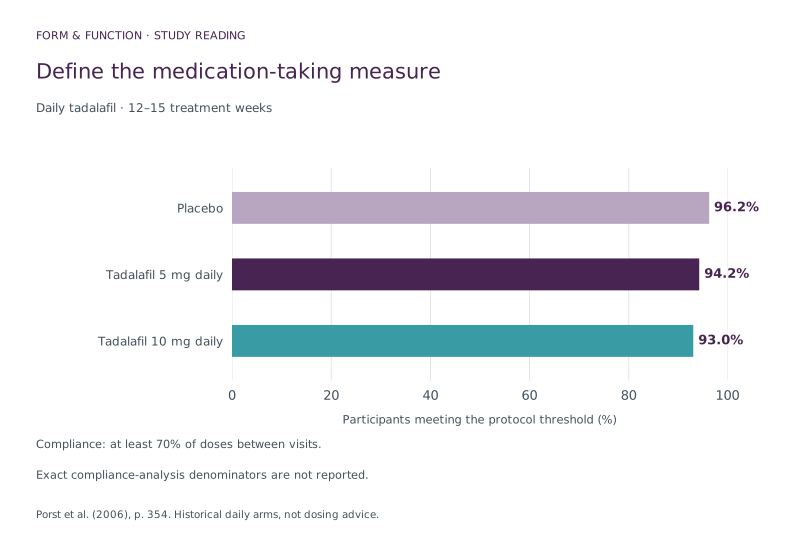
| Historical research arm | Reported percent | Exact analysis n |
|---|---|---|
| Placebo | 96.2% | Not reported |
| Tadalafil 5 mg daily | 94.2% | Not reported |
| Tadalafil 10 mg daily | 93.0% | Not reported |
Start with four different records
Separate the prescribed plan, the observed record, the classification rule and the clinical outcome before interpreting a result. The plan describes intended use. The record describes what was documented. A rule converts selected information into a label. An outcome describes the question investigators wanted to measure. Moving from one to another requires a stated definition; a familiar word such as compliance does not supply every missing connection.
The randomized tadalafil study used a daily schedule. Its compliance classification described dose-taking, not efficacy. Nine participants withdrew for adverse events. Lilly ICOS funded the study; company author affiliations, Lilly statistical analysis, and Lilly writing support were disclosed. The report did not directly compare daily and as-needed regimens.
Treat those facts as the setting for a measurement problem. A useful reading order is to identify the record first and ask what operation produced its summary. Only then consider whether that summary answers your question. Our guide to timing and medication frequency helps organize terminology for a clinician conversation; it does not convert a research classification into a personal schedule. The chart should therefore be read alongside its definition, not detached as a product score.
Sources: Porst 2006
A threshold compresses a detailed record
Imagine a fictional equipment log with ten planned checks. For this teaching exercise, the rule labels a log complete when at least eight checks are recorded. A log with eight checks and a log with all ten both pass. The rule has done exactly what it was designed to do: separate records at a boundary. It has also deliberately discarded the difference between those two passing logs.
That lost distinction cannot be restored by looking harder at the word complete. The original entries would be needed. Likewise, the two failing records with zero and seven checks share a label while containing quite different information. A binary classification has only two possible outputs, even when the underlying record has many possible values. Compression is useful for some questions precisely because it simplifies the record.
The scientific task is to decide whether that simplification fits the question being asked. If the question concerns how many logs crossed a defined boundary, the label is relevant. If it concerns the exact number of checks, the label is insufficient. Neither conclusion makes the rule inherently good or bad. It identifies the information needed for a particular purpose. This invented equipment rule is not a target for medication use.
Sources: Porst 2006
People passing and actions completed are different percentages
Extend the fictional equipment exercise to four operators, each assigned ten checks. Their records contain ten, eight, eight and two completed checks. Under the invented eight-check rule, three operators pass. Three divided by four is 75 percent. This calculation gives each operator one opportunity to appear in the passing category, regardless of how far above or below the boundary the record falls.
Now ask a different question: what fraction of all planned checks was completed? There are twenty-eight completed checks among forty planned checks, giving 70 percent. Because each operator had the same number of planned checks, this also equals the average of their individual completion percentages. Both answers are correct for this fictional dataset. Their difference comes from the question and denominator, not a disagreement in arithmetic.
The table makes the distinction visible before any interpretation is attached. It would be incorrect to describe the first answer as the average share of checks completed, or the second as the share of operators passing. A report should name the object being counted immediately after the percent sign. These invented calculations explain a reading principle; neither value estimates the tadalafil trial or describes actual participants.
| Operator | Completed / planned checks | Passes invented eight-check rule? |
|---|---|---|
| A | 10 / 10 | Yes |
| B | 8 / 10 | Yes |
| C | 8 / 10 | Yes |
| D | 2 / 10 | No |
Sources: Porst 2006
A total leaves the order of events behind
Two fictional ten-slot calendars can each contain eight recorded checks. In the first, the empty slots are adjacent. In the second, they are separated. Their totals match, and both cross the invented boundary, but their sequences differ. A tally alone cannot tell a reader which calendar produced it. To answer a question about spacing, the record must retain dates or another reliable ordering variable.
This is an information problem before it is a medical interpretation. A calendar might support a description of when documented actions occurred. It would not, by itself, explain why a gap occurred or establish its consequences. Explanations require additional observations and an appropriate analysis. Assigning a physiological meaning to an invented gap would turn a teaching example into an unsupported clinical claim.
A practical reading habit is to distinguish a quantity from its arrangement. Ask whether a displayed total preserves sequence, timing or duration. If it does not, those questions remain separate. Our guide to recording response provides a place to organize follow-up questions without changing treatment independently. A research threshold should never be treated as permission to omit prescribed doses or as a rule for handling a missed dose.
Sources: Porst 2006
Choose the weighting before combining intervals
Consider another fictional equipment record with two observation windows. Eight of ten checks were completed in the first window and one of two in the second. Pooling all opportunities gives nine completed checks out of twelve, or 75 percent. Averaging the two window percentages instead gives the average of 80 and 50 percent, which is 65 percent. The summaries differ because they assign different weights.
The pooled calculation gives every planned check equal weight. The simple average gives each window equal weight, even though one window contains many more opportunities. Neither arithmetic operation is automatically the right choice for every research question. The choice should follow the quantity the analysis intends to describe and should be stated before a reader tries to compare reports.
This example also shows why words such as overall or average need a definition. A percentage can combine observations across people, across intervals, or across both. Knowing that intervals exist does not establish how investigators aggregated them. These calculations are original illustrations, not an assertion about the study’s method. When an aggregation rule is unavailable, a careful reader leaves it unresolved instead of selecting whichever operation produces a preferred answer.
Sources: Porst 2006
A percentage does not reconstruct its sample
A reported percentage is a ratio after summarization, not a complete set of counts. In a fictional example, 50 percent could describe one of two records or fifty of one hundred. The same displayed value can therefore come from very different sample sizes. Rounding creates still more possibilities because several underlying ratios may map to the same printed decimal.
It is tempting to take a number found elsewhere in a paper and multiply it by the percentage. That only makes sense if the number is the denominator for that specific measure. Enrollment, assignment, completed visits and available records describe different stages of an investigation. A number associated with one stage cannot be moved into another calculation merely because it is nearby or familiar.
Without a supported denominator, reconstructed counts can look precise while resting on an unstated assumption. The same problem affects attempts to calculate an interval around the percentage or compare small differences. A reader needs the relevant analysis population, the way the measure was calculated and an appropriate uncertainty method. An empty field is more informative than an invented count because it shows exactly which part of the evidence is missing.
Sources: Porst 2006
Keep unknown entries distinct from recorded negatives
In a fictional inspection sheet, an empty box is not necessarily the same thing as a box marked not completed. The first says that a value is absent from the record. The second records a negative observation. A data dictionary should explain which interpretation applies, who made the entry and whether later clarification was allowed. Without that definition, counting every blank as a negative adds information that the record does not contain.
Imagine nine documented checks plus one unreadable entry. Declaring the actual total to be ten assumes a positive value for the unreadable slot; declaring it definitively nine assumes the slot was a negative. Preserving it as unknown keeps the distinction visible. An analyst might explore several assumptions, but those scenarios must be labeled as assumptions rather than reported as observations. The example is about recordkeeping, not a recommended method for a clinical trial.
This distinction also prevents borrowing a missing-data rule from the wrong endpoint. A study can collect several kinds of information, each with its own analysis. Knowing how one outcome handled absent values does not establish how another summary did so. The next question is therefore specific: which rule governed this particular record? If the report does not answer, the analysis should acknowledge that boundary rather than quietly fill the gap.
Sources: Porst 2006
A format claim needs a format comparison
Suppose a hypothetical study allows people to choose between package format X and package format Y, then compares their recorded use. Any difference could reflect the format, but it could also reflect who selected each option or another feature that changed with it. Listing these possibilities does not establish that any one explanation occurred. It identifies why a simple comparison may leave the causal question unresolved.
A design intended to test a format would need to specify the contrast carefully. What stays the same: ingredient, amount, instructions, observation period and access to follow-up? What changes? If several features change together, the resulting comparison addresses the package of differences unless the design can separate them. Randomizing one feature does not automatically randomize every other feature that a reader later becomes interested in.
This reasoning applies before a convenient format receives credit for a clinical result. Our companion analysis of sildenafil measurements and formulation claims examines the related task of matching an outcome to a product claim. The common principle is to identify the comparison actually supported by the evidence. A shared ingredient or an appealing format can motivate a question; neither supplies the missing comparison on its own.
Sources: Porst 2006
Build a record that keeps product, plan and outcome separate
An evidence worksheet can prevent several questions from collapsing into a single impression. Start with the exact product identity, then the prescribed plan, then the information collected during follow-up. Keep the desired outcome in its own field. This structure makes it easier to notice when a statement about one field is being used to answer a different question without the intervening evidence.
The worksheet below is an editorial organizing tool, not a validated clinical instrument. Its columns pair a question with the document that might answer it and the inference that should remain separate. A product description can help identify an item. A set of instructions can describe a plan. Neither document establishes what a particular person experienced. Those are different records, even when they appear in the same consultation or report.
For commercial documentation, our Ro tadalafil review and Hims tadalafil review provide starting points for checking current terms and exact product descriptions. These links do not establish that a provider offers the studied product or reproduces trial outcomes. A clear comparison names what was verified, the date of the record and what remains a question for the provider or prescribing clinician.
| Question | Record to seek | Inference to keep separate |
|---|---|---|
| What is the exact product? | Product and dispensing description | A description alone does not establish an outcome. |
| What plan was prescribed? | Individual prescribing instructions | Instructions alone do not establish observed use. |
| What happened during follow-up? | Defined observations and outcome records | A classification alone does not retain every detail. |
Sources: Porst 2006
Return to the current label before making a personal decision
Current CIALIS labeling for daily ED use starts at 2.5 mg, with possible increase to 5 mg; the historical 10 mg daily arm is not that labeling. Nitrates and guanylate cyclase stimulators such as riociguat are contraindicated. Assessment includes cardiovascular status, kidney or liver conditions, and interacting medicines. An erection lasting over four hours requires emergency care. Sudden vision loss or sudden hearing decrease or loss requires stopping the medicine and prompt medical attention.
Compounded medicines are not FDA-approved and do not undergo FDA premarket review for safety, effectiveness or quality. Our compounded-product guide helps separate product identity from ingredient familiarity. The statistical distinctions in this article do not establish equivalence between products. They show why a claim needs a defined product, a defined comparison and a measurement that fits the question.
For an individual discussion, bring unresolved questions to the clinician instead of translating a research category into a new regimen. The interactions guide can help organize that conversation. Keep the methodological lesson precise: a summary is useful for the question it was designed to answer, while other questions may require different records. Clear boundaries make a discussion more useful without pretending that a chart can choose a treatment.
Sources: Porst 2006; Cialis label; FDA compounding guidance
Questions about the evidence
Does crossing a study threshold mean every planned action occurred?
Not necessarily. A threshold divides records according to a rule, while the underlying records may still differ within each category. To determine whether every planned action occurred, a reader would need a measure that answers that exact question. The useful distinction is between membership in a category and the detailed observations from which the category was produced.
Sources: Porst 2006
Can a high classification percentage establish that a format is easier to use?
That would require a comparison capable of isolating the format question. A high percentage within one research setting does not supply the missing contrast. A proposed explanation should identify what changed, what remained comparable and how observations were collected. Without those elements, convenience remains a hypothesis to investigate rather than a result established by the classification alone.
Sources: Porst 2006
Why leave a denominator unknown when another sample size is available?
Because the relevant number is the count supporting that particular measure. Substituting a different count changes the calculation’s meaning and can create false precision. A transparent analysis identifies the missing field and explains which further record would resolve it. It does not turn an enrollment figure into an analysis denominator merely to make the arithmetic possible.
Sources: Porst 2006
Are the fictional calendar examples examples of patient behavior?
No. They are invented records of ordinary checks used to explain compression, weighting and missing information. They neither reconstruct trial participants nor predict a response to medication. Their arithmetic is deliberately separate from clinical decision-making. A reader should use them to interrogate the meaning of a summary, not to select a personal target or alter prescribing instructions.
Sources: Porst 2006
What would make a new evidence claim easier to assess?
State the exact product, schedule, population, comparison and outcome, then identify the record supporting each element. Explain how the outcome was counted and which uncertainties remain. That specification lets a reader see whether the evidence answers the proposed question or a narrower one. It also makes missing information visible without treating an unanswered question as proof of failure.
Sources: Porst 2006
Editorial assessment
A compliance percentage is most informative when its measurement rule remains attached. The stronger reading habit is to follow the chain from planned schedule to recorded observations, from observations to classification, and from classification to the question being asked. Each step can discard information or introduce an assumption. Form & Function’s assessment is therefore methodological: preserve those distinctions when comparing claims, and seek additional evidence when a new product, format or outcome changes the question.
Sources and access
- Oral sildenafil in the treatment of erectile dysfunction. Sildenafil Study Group.
Relevant methods, results and funding passages inspected in a retained full-text primary article.
Checked 2026-10-25.
- Evaluation of the efficacy and safety of once-a-day dosing of tadalafil 5mg and 10mg in the treatment of erectile dysfunction: results of a multicenter, randomized, double-blind, placebo-controlled trial.
Relevant methods, results and funding passages inspected in a retained full-text primary article.
Checked 2026-10-25.
- VIAGRA (sildenafil citrate) US prescribing information
Current official prescribing information inspected.
Checked 2026-10-25.
- Cialis (tadalafil) prescribing information
Current official prescribing information inspected.
Checked 2026-10-25.
- Understanding the risks of compounded drugs
Official FDA guidance inspected.
Checked 2026-10-25.