Reading sildenafil results before extending a formulation claim
An outcome has units, a comparison has boundaries, and a finished product has an identity. This study-reading framework keeps those records connected.
Published and source checked · 11 minute read
A familiar ingredient name can make a treatment claim sound more settled than its evidence allows. The useful question is specific: which observation supports which statement about which product? Answering it requires more than recognizing a drug name. It requires a clear description of the product, its intended use, the people studied and the outcome actually recorded.
This analysis uses a historical sildenafil report as a starting point for that reading process. The accompanying figure presents the selected study measurement. The explanations below develop original examples for interpreting its units and deciding what additional evidence a different claim would require. Every invented number is identified as an illustration. None is a personal treatment target, an estimate of an individual outcome or a comparison of providers.
Reading the evidence
- Specify the claim
- Identify the product, regimen, people, outcome and observation window before matching evidence.
Sources: Goldstein 1998
- Keep the unit attached
- An event count and a proportion of people answer different questions.
Sources: Goldstein 1998
- Separate changed features
- Changing both ingredient and format leaves more than one possible explanation for a difference.
Sources: Goldstein 1998
- Ask for the missing comparison
- Evidence for a component does not supply an observed comparison involving every proposed combination.
Sources: Goldstein 1998; FDA compounding guidance
- Read precision carefully
- Displayed decimal places do not describe all the uncertainty in a group estimate.
Sources: Goldstein 1998
The outcome unit belongs to the claim being evaluated.
Historical tablet research does not directly establish results for another formulation.
Sources: Goldstein 1998
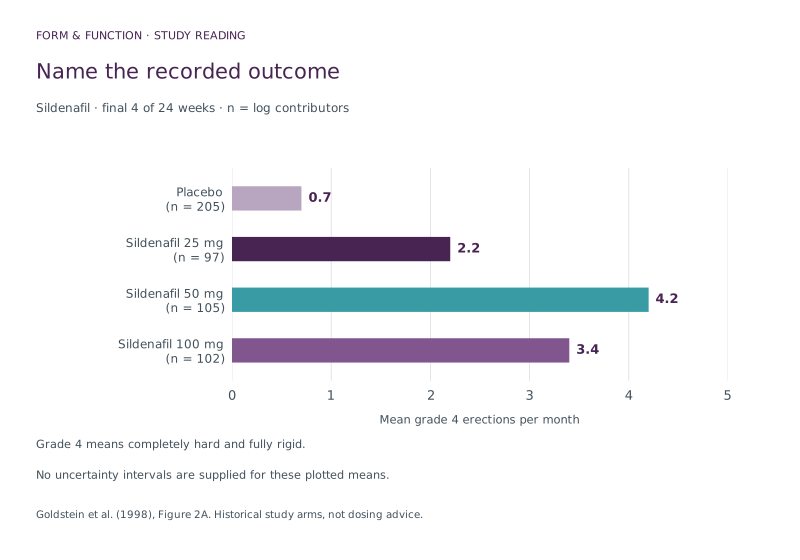
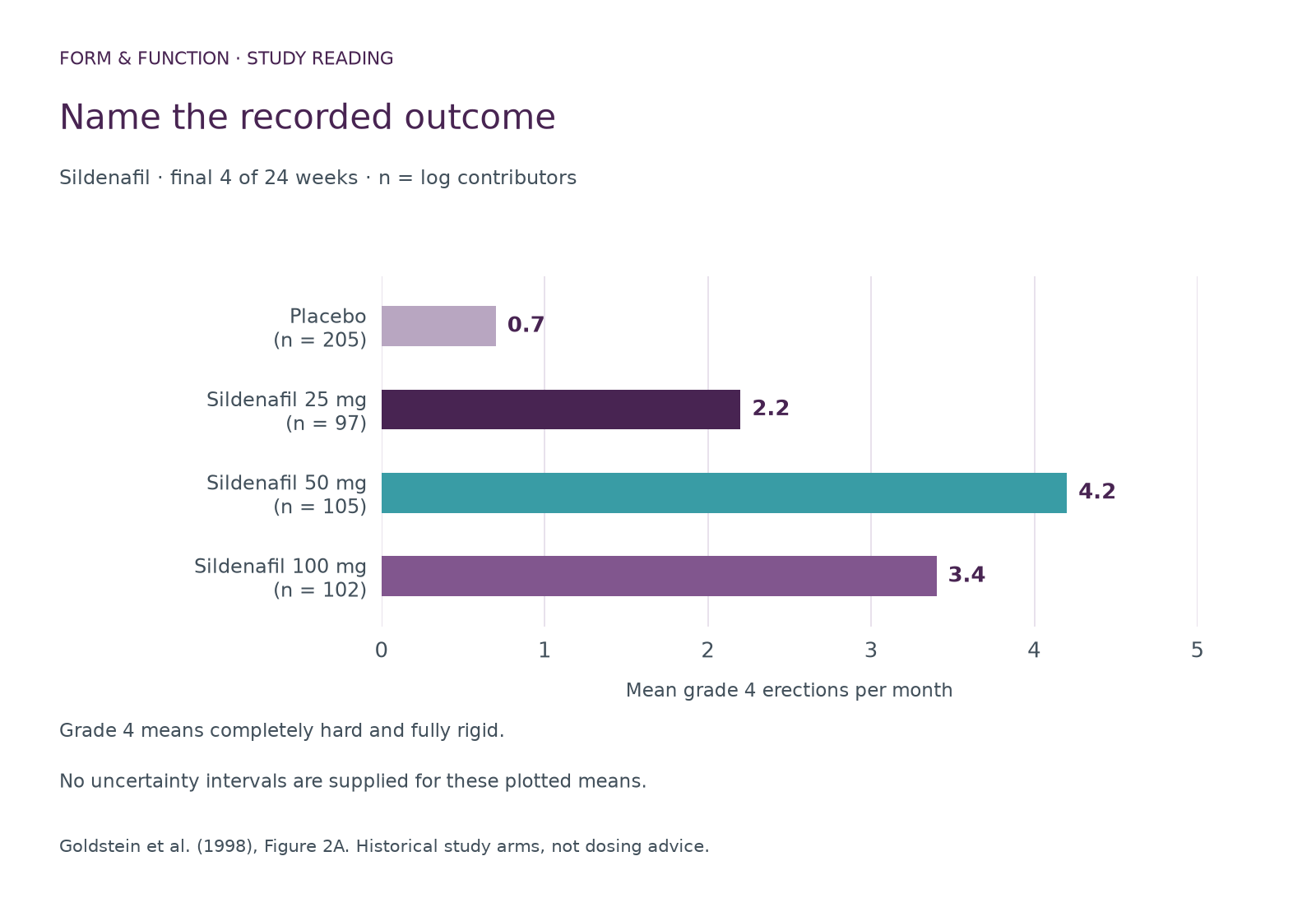
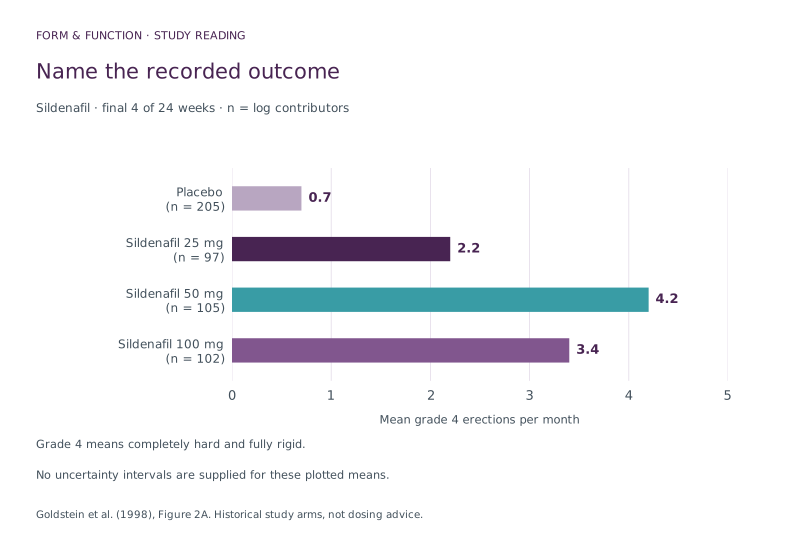
| Historical research arm | Mean monthly count | Log contributors |
|---|---|---|
| Placebo | 0.7 | 205 |
| Sildenafil 25 mg | 2.2 | 97 |
| Sildenafil 50 mg | 4.2 | 105 |
| Sildenafil 100 mg | 3.4 | 102 |
Describe the statement before judging its support
The randomized study compared oral sildenafil tablets with placebo. Its event logs classified erection hardness. Pfizer funded the research and supplied study products; authors disclosed consulting and company affiliation. Headache, flushing, dyspepsia and visual disturbances were reported. These were historical research arms, not instructions for another product.
For an original evidence worksheet, separate six fields: active ingredient, finished product, regimen, population, measured outcome and observation window. A broad statement such as “this works better” leaves several fields blank. Better at what, compared with what, and under which conditions? Filling those blanks creates a question that a study could actually answer. It also makes unsupported extensions easier to identify without assuming that the entire claim must be either true or false.
A match in one field does not complete the worksheet. Ingredient identity, for example, is a different entry from the physical product being evaluated. This worksheet is an editorial reading aid, not a regulatory equivalence test. Our guide to building a clinical picture before considering medication format provides a place to organize the personal questions separately from the research question.
Sources: Goldstein 1998
Decide what qualifies as a recorded event
A measurement begins with a rule about what counts. Consider an invented workshop observation sheet that records completed demonstrations. If the rule counts a demonstration only after every required step is finished, a partly completed demonstration does not qualify. A second observer using a looser rule might record more events from the same underlying activity. That difference would concern classification before it concerned performance.
The example shows why a category name needs a definition. A label can describe an observation without explaining its biological cause, duration or significance to the person involved. It is also possible to record the occurrence of an event while leaving its surrounding context undocumented. Those are separate dimensions of the record, and a reader should resist filling them in from the apparent familiarity of the label.
When reading a figure, locate the event definition before interpreting the height of a bar. Then distinguish the rule used to count observations from the broader question you hoped the study would answer. For practical record organization, tracking response without changing a dose yourself offers related discussion. The purpose of keeping records is to make questions clearer, not to turn a chart into a self-directed experiment.
Sources: Goldstein 1998
An average cannot reveal the whole distribution
Here is an explicitly invented arithmetic example, unrelated to any trial participants. Four people record zero, one, three and eight qualifying events during the same observation window. Their total is twelve, so their mean is three events per person. Three of the four recorded at least one event, making that separate proportion seventy-five percent. The mean and the proportion are both correct descriptions of this fictional record.
Now imagine another fictional record in which all four people record three events. The total and mean are unchanged, but everyone has at least one event. The average therefore cannot identify the proportion with any event. Nor can it show whether observations were concentrated in a few people or spread evenly across the group. Recovering those features requires more detail than a single mean contains.
This is a mathematical limitation, not a criticism of averaging. A mean is useful when the question concerns the average number of recorded events. It becomes misleading when silently translated into a different outcome, such as a probability that a person experiences any benefit. Before making that translation, ask which additional participant-level record would be needed and whether it is actually available.
Sources: Goldstein 1998
Check the unit and the observation window together
A number should travel with its unit. A count within a period, a proportion of people, a questionnaire score and an elapsed time are different kinds of information. Even when two numbers look similar, their units can prevent a meaningful comparison. A statement about speed, for example, needs information about timing. A count without timestamps cannot by itself identify how quickly the counted events occurred.
Consider a fictional nonclinical example: two completed tasks in one week and four completed tasks in four weeks. Dividing by the respective observation periods gives two and one tasks per week. That conversion answers a simple arithmetic question. It does not show that either rate would remain stable, that the opportunities were comparable or that the two records describe equivalent circumstances.
A study-reading note should therefore retain both the reporting unit and the original window. Converting a unit should not erase the conditions under which it was observed. Our companion analysis of daily-tadalafil records and classification explores a related distinction between a planned schedule and the record used to summarize it. The comparison here concerns measurement logic, not a ranking of medicines.
| Question being asked | Needed record | Information not supplied by that record alone |
|---|---|---|
| How many events occurred? | Count plus observation window | How many people had any event |
| How many people met a definition? | People meeting it and eligible denominator | Number of events per person |
| How quickly did something happen? | Relevant start and event times | Whether a different product would act similarly |
Sources: Goldstein 1998
Separate ingredient differences from format differences
An imagined research design can clarify why product descriptions matter. Call two ingredients A and B, and two formats X and Y. Comparing product AX with product BY changes both ingredient and format. If the recorded outcomes differ, that single comparison does not isolate which changed feature explains the difference. This is a design example, not a report of a completed medical experiment.
Additional comparisons could ask more focused questions. Comparing AX with AY holds the ingredient label constant while changing format; comparing AX with BX holds the format label constant while changing ingredient. Even those comparisons would require suitable assignment, consistent outcome measurement and attention to other differences. Writing four labels on a page does not guarantee that actual products differ in only the named feature.
The practical reading lesson is to list what changed between the groups before attributing a result to one feature. If a claim concerns a particular format, ask whether that feature was actually compared under a design capable of addressing the claim. An ingredient study may be relevant background while leaving that narrower question open. Relevance and direct demonstration are different descriptions of the evidence.
Sources: Goldstein 1998
Adding a component creates another comparison
A similar distinction applies to an imagined combination. Suppose evidence compares component A with a control. A later question asks whether A plus B performs differently from A alone. The first comparison does not contain an observed A-plus-B group. There is no arithmetic operation that can manufacture the missing comparison merely by appending another ingredient name to the original result.
This reasoning does not assume that adding B helps, harms or changes nothing. It identifies an unanswered question. A proposed explanation for why a combination might work is also different from a measurement of what the finished combination does. Clear analysis keeps the explanation, the tested product and the observed comparison in separate entries rather than allowing one to stand in for the others.
Our discussion of ingredients and finished compounded formulations develops the product-identity question further. For a claim about a combination, an evidence request should name the exact comparison and the outcome of interest. That is more informative than asking whether each component has ever appeared in research. It also prevents the number of ingredients from becoming an unsupported measure of expected performance.
Sources: Goldstein 1998; FDA compounding guidance
Rounding is different from statistical uncertainty
Displayed precision can create an impression of certainty that the underlying number does not establish. In a purely hypothetical example, means of 3.16 and 3.24 both round to 3.2 when shown to one decimal place. Identical displayed values would conceal their small numerical difference. Conversely, different displayed means would not, by themselves, demonstrate a reliable difference between the groups being compared.
Rounding concerns how a value is written. Statistical uncertainty concerns how much confidence a particular design and dataset justify placing in an estimate or comparison. Calculating that uncertainty needs appropriate information; adding decimal places to a chart does not provide it. A reader should also distinguish uncertainty about a measured comparison from uncertainty created by applying that comparison to a different question.
For a disciplined interpretation, write down the estimate first and the inferential claim separately. “These displayed values differ” is not the same statement as “one option has been shown superior.” If the evidence needed for the second statement is unavailable, leave that statement unresolved. Do not borrow an interval from a different endpoint or imply that an absent error bar means there was no variability.
Sources: Goldstein 1998
Follow the contributors to the particular result
A paper can contain several records about the same research program. One may describe who was assigned, another who supplied a questionnaire, and another who contributed an event log. These are possible record types, not interchangeable denominator labels. The reading task is to locate the record supporting the particular displayed statistic rather than selecting whichever group size is easiest to find.
An invented filing example makes the issue concrete. A project has a registration list, an attendance list and a completed-form list. Counting registrations answers how many registered; counting completed forms answers how many forms were returned. Without inspecting the relationship between the lists, the reader cannot decide which missing entries overlap or why an entry is absent. A label on one list does not resolve those questions for the others.
Keep a small provenance note beside an extracted result: where it appears, which contributors it describes, the unit and any stated handling of incomplete records. If a detail is not established, preserve that gap. Rounded averages should not be multiplied into supposedly exact raw event totals. This approach makes later checking possible while avoiding a more complete-looking reconstruction than the available information supports.
Sources: Goldstein 1998
Use a product claim worksheet without inventing evidence
The second worksheet turns these distinctions into an editorial method. Start with the actual wording of a claim, then identify the evidence field it needs. A statement about a product feature calls for product documentation. A statement about a clinical comparison calls for an appropriate outcome comparison. Neither should be silently replaced with an administrative detail such as how an order is arranged.
For documentary checking, our Ro Sildenafil review and Hims Sildenafil review can help organize questions about stated product identity and current terms. These links do not establish which finished product an individual would receive or transfer a study outcome to either provider. Any current offer should be checked in its own documentation.
A useful worksheet can end with an unanswered field. That is preferable to replacing an unknown with a general statement about a familiar ingredient. Record what would resolve the question: an exact product description, a defined comparison, an outcome definition or a follow-up record. The result is a more precise request for evidence, not a score or a recommendation generated from incomplete information.
| Proposed claim | Field to inspect | Additional record to request |
|---|---|---|
| This exact format performs differently | Finished product and comparator identities | A suitable comparison involving those products |
| An added component improves the result | Combination versus component comparison | Defined outcome data for that contrast |
| A reported result applies to my question | Population, outcome and time window | Evidence addressing the remaining mismatch |
Sources: Goldstein 1998; FDA compounding guidance
Keep current safety information separate from the chart
Current VIAGRA labeling prohibits use with organic nitrates or nitrites and guanylate cyclase stimulators such as riociguat. Medical assessment includes cardiovascular status and interacting medicines. Combining ED therapies has unestablished safety and efficacy and is not recommended. An erection lasting more than four hours requires immediate medical care. Stop use and seek medical attention for sudden vision loss; stop use and seek prompt attention for sudden hearing decrease or loss.
Compounded drugs are not FDA-approved and do not undergo FDA premarket review for safety, effectiveness or quality. These regulatory facts and the current safety information belong beside the evidence discussion, not inside an invented calculation of personal benefit. Our guide to interactions across medication formats can help organize the questions to take to a qualified clinician.
The final reading step is to separate three documents: the research report, the current product information and the individual clinical plan. A figure describes a research observation. Product information identifies current restrictions and warnings. A clinician must assess the personal situation. Keeping those roles visible prevents an attractive graph or a familiar ingredient from becoming an instruction to change, combine or substitute treatments.
Sources: Viagra label; FDA compounding guidance
Questions about the evidence
Does missing direct evidence mean a formulation is ineffective?
No. An unresolved comparison is not a measured finding of no effect. The useful response is to specify the missing question and the evidence needed to answer it. Neither assuming benefit nor assuming failure fills that gap. The distinction concerns what has been established, rather than a prediction about every possible product.
Sources: Goldstein 1998; FDA compounding guidance
Can an average tell me my chance of a useful result?
An average describes the quantity being averaged. A personal probability requires a different question and supporting information. Even a proportion of people meeting a study definition would need careful interpretation before application to an individual. Begin by asking what the reported unit measures and what information the proposed translation would require.
Sources: Goldstein 1998
Why not select whichever displayed bar is tallest?
A bar represents a defined summary, not a complete treatment decision. Its height does not supply every relevant comparison, the uncertainty in that comparison or the personal context. First identify the outcome and the study contrast. Then distinguish a numerical ordering from a justified claim about superiority or individual suitability.
Sources: Goldstein 1998; Viagra label
Is matching the ingredient enough to match the evidence?
Ingredient identity is one field in the evidence worksheet. Product, regimen, people, outcome and observation window remain separate fields to check. A match can make evidence relevant while leaving an extension unresolved. The next step is to name the remaining mismatch rather than treating relevance as proof of every proposed claim.
Sources: Goldstein 1998; FDA compounding guidance
What should a useful evidence question sound like?
It should identify the exact product or feature, the comparator, the outcome and the observation period. For example, ask what record would support the specific difference being claimed, and whether that record concerns the finished product in question. This structure invites a verifiable answer without presuming that a missing comparison has already been performed.
Sources: Goldstein 1998
Editorial assessment
The strongest use of a study figure is to sharpen a question. Keep the measured unit, contributor record and comparison attached to the result; then identify which parts of a proposed formulation claim match and which remain open. Original worksheets and hypothetical arithmetic can expose those distinctions, but they cannot add observations to the study. For Form & Function, that boundary is central: a clear product description and a clear evidence description should meet in an explicit, checkable comparison. When they do not, the analysis should identify the additional record needed rather than manufacture a clinical ranking.
Sources and access
- Oral sildenafil in the treatment of erectile dysfunction. Sildenafil Study Group.
Relevant methods, results and funding passages inspected in a retained full-text primary article.
Checked 2026-10-25.
- Evaluation of the efficacy and safety of once-a-day dosing of tadalafil 5mg and 10mg in the treatment of erectile dysfunction: results of a multicenter, randomized, double-blind, placebo-controlled trial.
Relevant methods, results and funding passages inspected in a retained full-text primary article.
Checked 2026-10-25.
- VIAGRA (sildenafil citrate) US prescribing information
Current official prescribing information inspected.
Checked 2026-10-25.
- Cialis (tadalafil) prescribing information
Current official prescribing information inspected.
Checked 2026-10-25.
- Understanding the risks of compounded drugs
Official FDA guidance inspected.
Checked 2026-10-25.